
Portal Cranes
When it comes to designing and manufacturing single and semi-portal cranes, our decades of experience in the lifting industry make us the ideal company to help you find a system tailored to your needs.
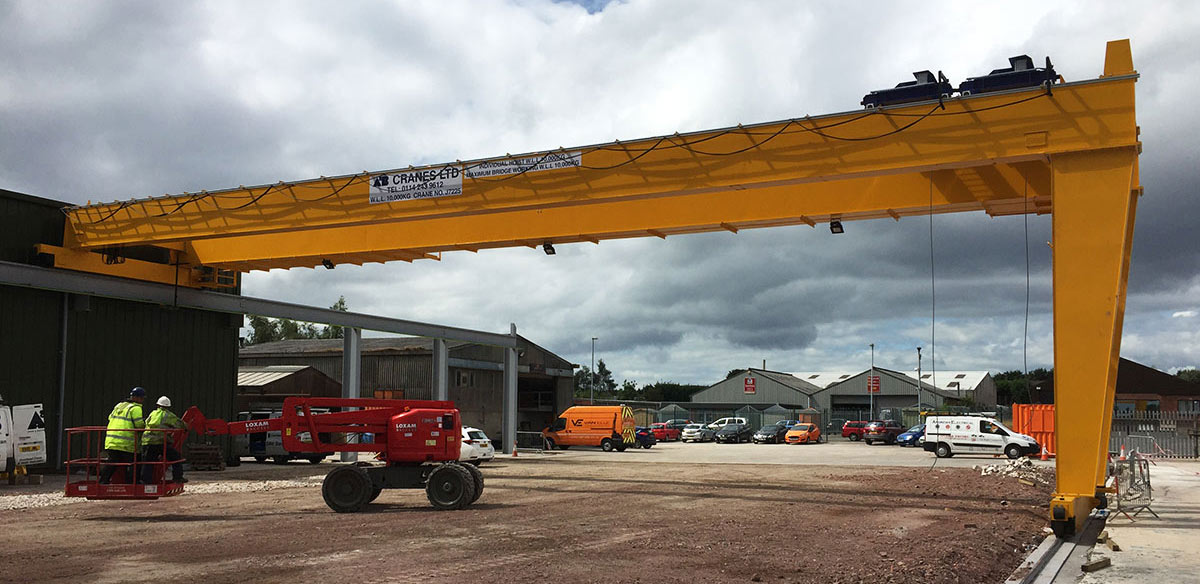
Semi-portal cranes, which utilise one raised and one floor mounted rail to support a single beam or multiple beams, are an excellent lifting solutions for many applications as they allow you to get more from the available space in your working environment.
Tailored semi-portal cranes
Our team of designers use the latest computerised technology to tailor every semi-portal crane system to the task in hand. Whether you’re an end user with a specific requirement for your workplace, or a trade client that is supplying a semi-portal crane for a third party – we have experience in designing semi-portal cranes of all sizes, any capacity and for use in a various sectors and industries.
We can manufacture and supply all the components of your semi-portal crane including the girder beam and gantry rails. We also offer a series of semi-portal crane extras, such as walkways, floodlights, beacons and alarms.
To get a free, fast semi-portal crane quotation, call our team on 0114 243 9612 or email your enquiry to at info@abcranes.co.uk.
What is the primary function of a portal crane?
Portal cranes are heavy-duty lifting machines primarily used for moving, lifting, and transferring substantial loads over a wide area. Their most common applications are in:
-
- Ports and Shipyards: Loading and unloading cargo from ships (especially containers and bulk materials) and assembling large ship sections.
- Stockyards and Railyards: Handling materials like steel, concrete, or moving large rail containers.
- Construction Sites: Lifting and positioning heavy structural components.
They are essentially an overhead crane mounted on legs that travel on ground-level rails, eliminating the need for a supporting building structure.
What are the main types of portal cranes?
The two main types are differentiated by their support structure:
- Full Portal (or Goliath) Cranes: These cranes have a bridge supported by two legs that run on two parallel rails mounted on the ground. This configuration maximises lifting area and stability, making them ideal for large outdoor stockyards.
- Semi-Portal Cranes: These have a bridge supported by one leg running on a ground-level rail, with the other side of the bridge supported by a high-level rail (often attached to a building or wall structure). This design saves floor space and is suitable for both indoor and outdoor use, sometimes operating underneath a larger overhead crane.
What are the key features of a portal crane's design?
Key features of a portal crane’s design include:
- Gantry Structure: The characteristic “portal” or “gate-like” frame composed of the bridge (girder) and two support legs.
- Mobility: They travel along fixed ground-level rails, allowing them to cover large, linear work areas.
- High Capacity and Span: They are built to handle very heavy loads (sometimes hundreds of tonnes) and span large distances, making them suitable for handling large, bulky materials.
- Cantilevers (Optional): Many designs feature overhanging beams (cantilevers) that allow the lifting trolley to extend beyond the rail centres, maximising the working area for loading and unloading outside the track boundaries.
What are the crucial safety regulations for operating portal cranes?
Safety regulations revolve around preventing structural failure, tipping, and injury:
- Load Management: Operators must strictly adhere to the Rated Capacity (load limits) and use weighing systems to avoid overloading.
- Inspections and Maintenance: Regular and thorough inspections (often daily pre-use checks, and periodic statutory inspections like those mandated by LOLER in the UK) are required for all critical components like ropes, hooks, brakes, and electrical systems.
- Operational Rules: Prohibitions include side-pulling (dragging a load laterally), moving loads over personnel, and operating during high winds or other adverse weather conditions.
- Operator Training: All operators must be professionally trained and certified to ensure they follow all safe operating procedures and signalling protocols.