
Top Running Cranes
As a leading lifting equipment manufacturer, A & B Crane and Electrical Services Limited have considerable experience when it comes to designing and supplying top running cranes. We can produce a top running crane tailored around your needs, to meet any requirement whether you’re the end user of the system or a business working within the lifting industry. Top running cranes, also referred to as top running bridge cranes and overhead cranes, get their name from their end carriages that support horizontal beam or beams which span the width of the system and sit on top of the gantry rail supports. This is as opposed to underslung crane designs, in which the end carriages run underneath the gantry framework.
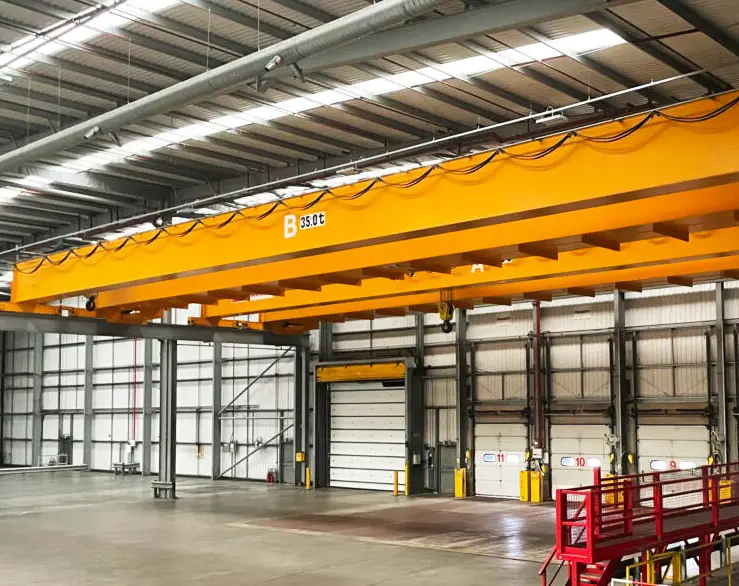
Single and double girder top running cranes
We customise all of our top running cranes to meet the lifting application in hand, which means we offer both single beam and double girder top running overhead crane designs. Generally a double girder top running crane will be used for heavier duty tasks as the stress of the load being supported is spread across two beams.
Top running cranes are a common type of overhead crane
To receive a free top running crane quotation, get in touch with our team via 0114 243 9612 or email your enquiry to info@abcranes.co.uk.
What are the main benefits of choosing a Top Running configuration?
- High Capacity: They are designed for extremely heavy loads, with capacities often exceeding 100 tons.
- Maximum Lift Height (Hook Height): Because the crane sits on top of the runway, and the hoist/trolley can ride on top of the girders, they provide the best possible vertical hook travel, which is crucial in buildings with limited headroom.
- Wider Spans: Top running cranes can typically accommodate wider spans than under running cranes.
- Easier Maintenance: Since the end trucks and rails are externally accessible on top of the runway, installation, inspection, and maintenance of the components are often simpler and require less downtime.
What are the two primary girder configurations for Top Running cranes?
Top Running cranes come in two main configurations:
- Single Girder: Utilises one horizontal bridge beam. The trolley and hoist typically run on the bottom flange of this single girder. This is cost-effective for lighter to medium duty applications (e.g., up to 20 tons).
- Double Girder: Utilises two horizontal bridge beams. The hoist and trolley typically run on rails on top of the two girders. This configuration offers the highest capacity and maximum hook height and is ideal for medium to heavy-duty applications (e.g., 20 tons and above)
What industries and applications commonly use Top Running cranes?
Due to their high capacity and rugged design, Top Running cranes are essential in:
- Steel Mills and Foundries: Handling molten metal, heavy castings, and coils.
- Large Fabrication and Stamping Facilities: Moving large metal plates, dies, and fabricated sections.
- Power Plants and Paper Mills: Handling heavy machinery and components for maintenance and production.
- Heavy Manufacturing: Moving large machinery and equipment during assembly.
- Shipping and Ports: Loading and unloading massive cargo.
What is "hook height" and why is it important for Top Running cranes?
Hook height (or “height of lift”) is the maximum vertical distance from the floor to the crane’s load hook when fully raised. Top Running Double Girder cranes provide the greatest hook height because the hoist and trolley carriage sit between and on top of the two bridge girders, saving several feet of valuable vertical space compared to other designs.